
Who is La Catrina? History, Meaning, and Day of the Dead

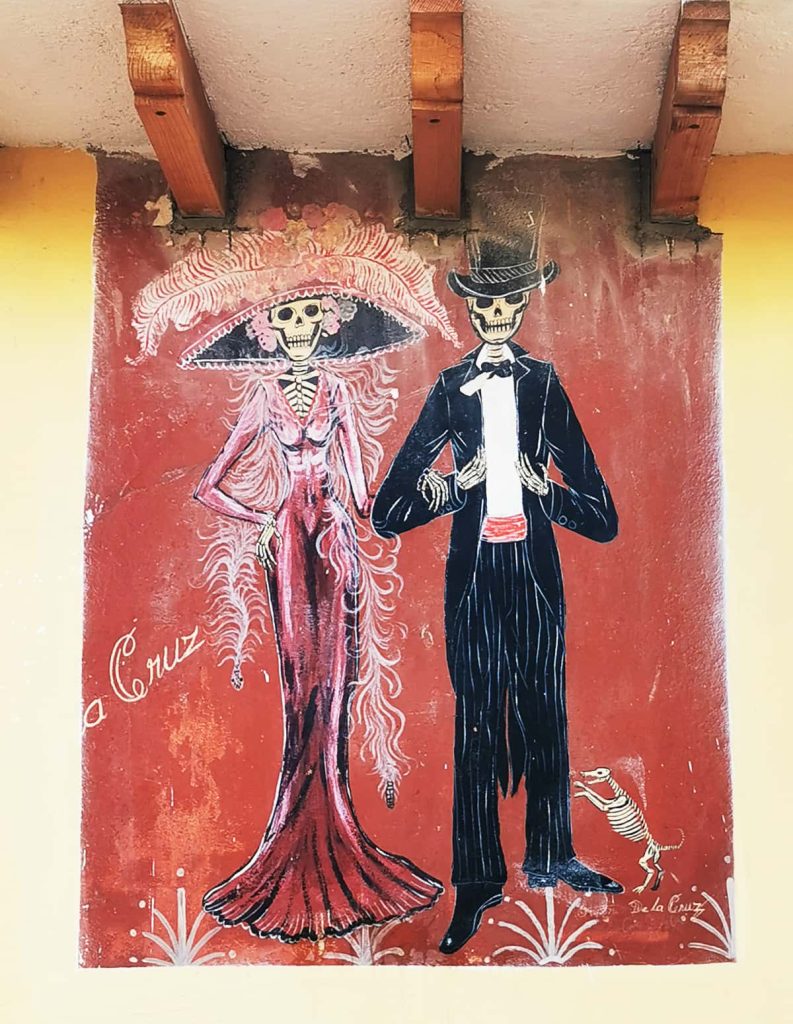
La Catrina is one of the most recognizable figures associated with Day of the Dead, yet her origins are often misunderstood. What emerged as a sharp social satire in early 20th-century Mexico later evolved into a powerful cultural symbol. Today, La Catrina represents themes of mortality, class, identity, and remembrance within Día de los Muertos.
Understanding the history and meaning of La Catrina reveals her not as a decorative figure, but as a reflection of Mexico’s relationship with death. La Catrina’s endurance as a cultural icon lies in Mexican culture’s ability to transform criticism, pain and tragedy into humor and shared identity.
Who is La Catrina? Let’s explore the origin of La Catrina, her meaning, and how she became intertwined with Day of the Dead. At the end, you’ll have the context that reveals her transformation and why she endures as a beloved icon in Mexican culture.
This article may contain affiliate links. This means if you click a link on my website and make a purchase, I earn a commission at no additional cost to you. For full information, please see my disclaimer here.
History of La Catrina
La Catrina’s origins lie in political satire rather than ritual tradition. Understanding the meaning of La Catrina requires looking at Mexico’s social landscape at the turn of the 20th century, when art became a tool for criticism, resistance, and cultural commentary.
La Catrina was created by Mexican illustrator and printmaker José Guadalupe Posada in the early 1900s. Originally named La Calavera Garbancera, the image he created depicted a female skeleton wearing an elaborate European-style hat.

Posada intended it as a visual critique of working class Mexicans, particularly those of Indigenous heritage who rejected their roots in favor of European aristocratic ideals.
Who was José Guadalupe Posada?
José Guadalupe Posada was a working class artist and printmaker who often critiqued the upper class. His creation of Calavera Garbancera in the early 1900s called out those whom he viewed as class traitors and social climbers. But his critique lacked nuance regarding why some indigenous or working class people might have to “pass” in order to make a living.

Garbancero is a negative term that referenced people with indigenous roots who stopped selling maize in favor of selling garbanzos. This was seen as an affront to cultural and traditional sustenance by working class and indigenous Mexicans.
His work ultimately targeted a marginalized group seeking stability for themselves, rather than attacking the class system and racism that created the imbalance.
While La Catrina has evolved from her original significance as a figure of satire to a representation of contemporary Mexican culture, it’s important to keep her origins in mind.

From Satire to Cultural Icon for Day of the Dead

Posada’s prints circulated widely in newspapers and broadsheets, making his imagery accessible to the working class. However, it wasn’t until decades later that the figure gained the name La Catrina. The name derived from Catrín, a term for a well-dressed, upper-class gentleman.
This transformation marked a shift. What began as satire slowly evolved into a broader cultural symbol, no longer mocking class aspiration alone, but reflecting Mexico’s complex relationship with death, identity, and memory.
One of the most influential reinterpretations of La Catrina appears in one of the most famous Diego Rivera murals in Mexico City pictured below. In this work, Rivera depicts La Catrina in full Victorian dress, standing at the center of Mexican history and holding hands with a young Rivera himself.
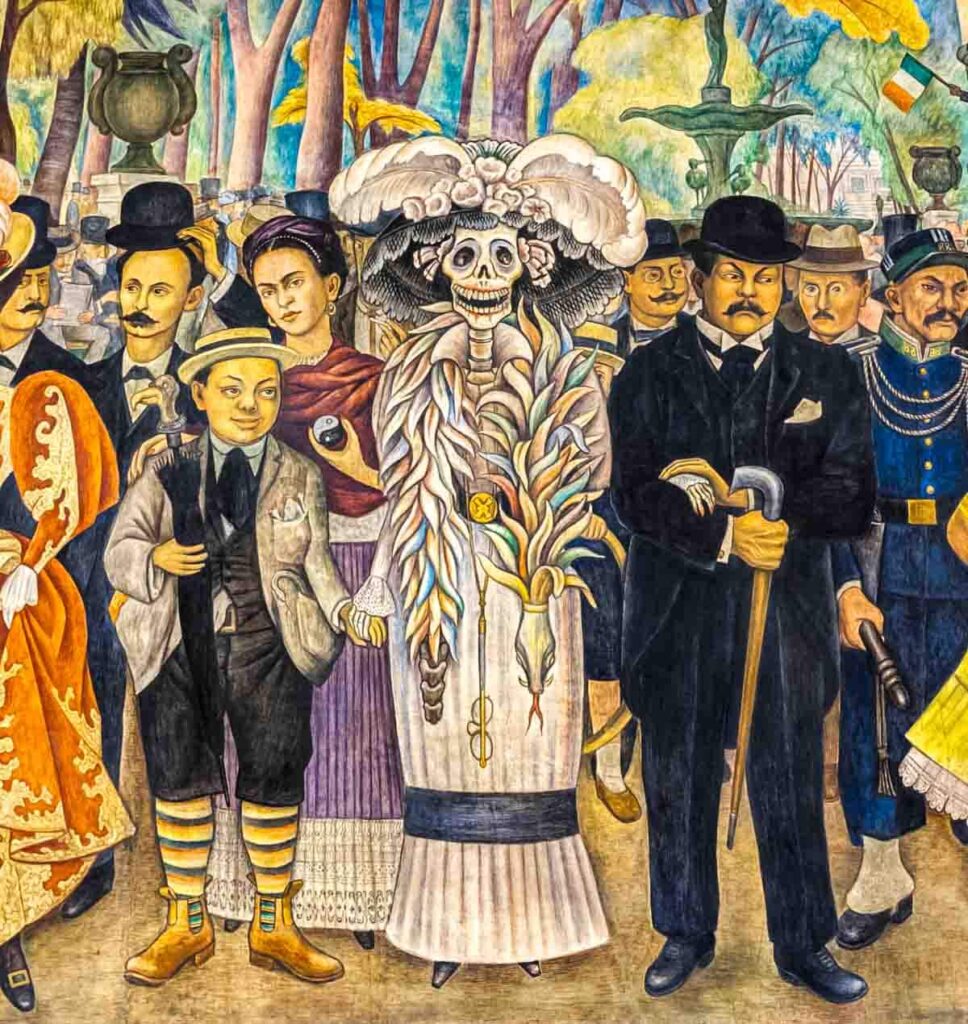
This mural solidified La Catrina’s place in the national imagination, transforming her from a satirical skeleton into a timeless cultural icon. Rivera positioned her among political leaders, revolutionaries, and everyday citizens, suggesting that death and history connects all Mexicans.
La Catrina’s endurance as a cultural icon lies in Mexican culture’s ability to transform criticism, pain and tragedy into humor and shared identity.
– Xochitl (author)
This marked the evolution of La Catrina as death, the great equalizer and positioned her as a figure that united Mexicans across social class, race and identity. The integration of La Catrina for Day of the Dead in Mexico hinged on her representing every Mexican across race, class and social status.
La Catrina Meaning
At her core, La Catrina represents the inevitability of death and the illusion of social hierarchy. Her elegance is intentional. She is refined, composed, and dignified, reminding viewers that death spares no one, regardless of wealth or status.
In modern interpretations, La Catrina also carries meanings of:
- Acceptance of mortality
- Cultural pride and Mexican identity
- Death as transformation, not finality
- Remembrance without fear
Death is not solely viewed as tragic in Mexican culture. La Catrina captures the relationship to death as a transformative process rather than a finality.
For this reason, during Day of the Dead, La Catrina represents coexistence with death. She is a modern-day echo of pre-Hispanic belief systems in which death is not the end of life, but a continuation of it.

Who is La Catrina in the Day of the Dead?
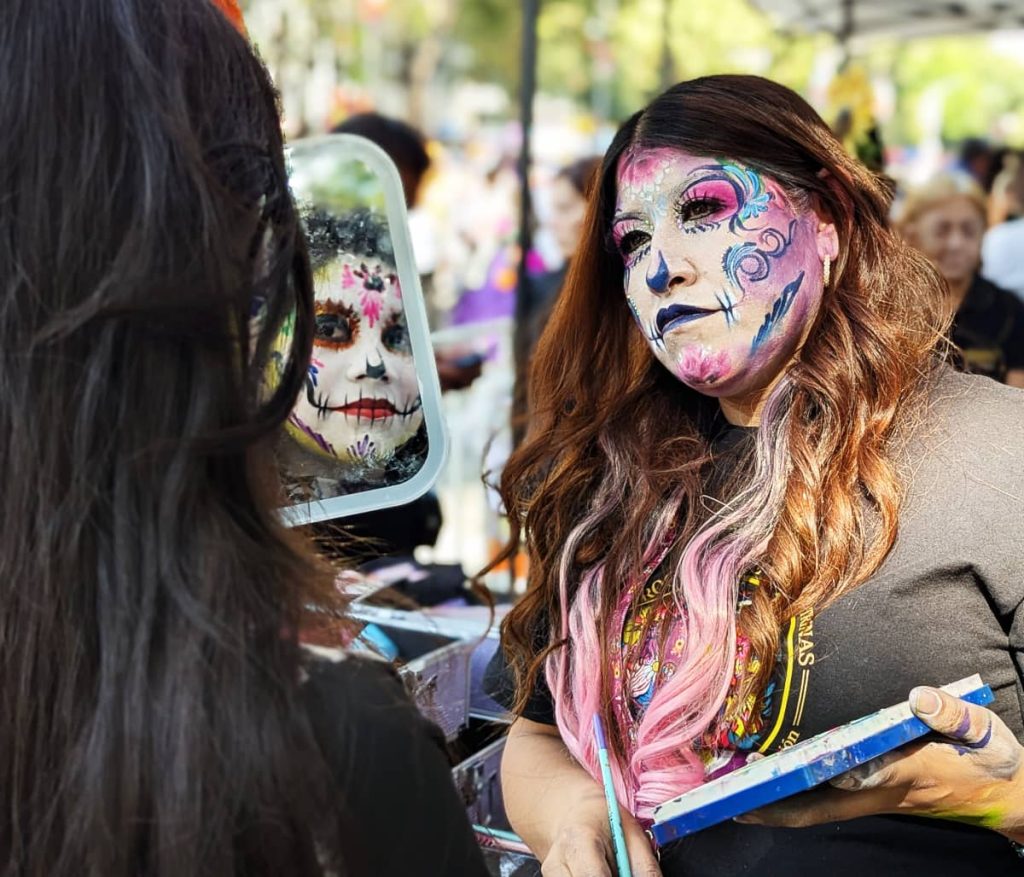
La Catrina is one of the most visible symbols of Day of the Dead. Over time, artists, communities, and celebrations incorporated her image into Día de los Muertos as a visual shorthand for the holiday’s themes. She is a reminder that death is universal and that honoring the dead can coexist with beauty, humor, and artistry.

More Questions About La Catrina
What is the story behind La Catrina?
The story behind La Catrina begins with José Guadalupe Posada’s satirical illustration. Originally named La Calavera Garbancera, it criticized class aspiration and European imitation in Mexico. Over time, the figure was renamed La Catrina and transformed into a broader symbol for Day of the Dead representing mortality, equality, and cultural identity.
Who is Catrina on Day of the Dead?
On Day of the Dead, La Catrina is not a specific person or spirit. La Catrina is a symbolic figure representing death itself: unavoidable and shared by all. Her presence during Día de Muertos reinforces the holiday’s message that death is a natural part of life and remembrance.
What does La Catrina symbolize in Day of the Dead?
During Day of the Dead La Catrina symbolizes the universality of death and the idea that social status holds no power beyond life. Within Day of the Dead, she also represents acceptance, humor, and cultural continuity, reflecting a worldview where death is honored rather than feared.
What is a fun fact about La Catrina?
A fun fact about La Catrina is that despite her modern day depiction in elegant dress, she originally had no clothes at all, only a hat. Her now iconic elegant dresses were added later by artists like Diego Rivera, who reimagined her as a fully adorned figure representing Mexican history and identity.
Wrapping Up La Catrina History and Meaning
La Catrina’s lasting power lies in her evolution. What began as sharp social satire grew into one of the most recognizable symbols of Day of the Dead, embodying themes of mortality, equality, and remembrance.
Today La Catrina is a treasured figure in Mexican art. She is often seen around events and celebrations for Day of the Dead, representing Mexicans across race and social class.
